Mini DisplayPort to Get Some HDMI Competition

Back in 2008, Apple introduced the new Mini DisplayPort standard as the only video output method on the new MacBooks and LCDs. Mini DisplayPort is a freely-licensed VESA standard [1] and has now been adopted by a number of other display manufacturers, and is a miniaturized version of the original DisplayPort interface.

This week, the fourth revision of the HDMI high-definition video output connector was revealed in the form of HDMI D, weighing in at a mere fraction of the original HDMI connector size and intended for use with mobile and embedded high-definition video devices [2]. The new HDMI connector is expected to ship later this year, and is in direct competition with VESA’s Mini DisplayPort interface.

VESA is the international governing body for computer graphics standards, and has been designing video output standards since its conception in the late 80’s [3]. HDMI is a private group formed in 2002, and licenses its interfaces out to manufacturers at four cents a device + a $10,000 yearly fee.

Continue reading

On the matter of Firefox and memory leaks…

Recently our original article/rant on Firefox’s legendary memory abuse has seen an increase in comments and views; and I had intended to post the following comment in light of the article’s rebirth and the ensuing discussions in the comments.

The reply turned out to be longer than I’d originally intended, so here it is as its own post.

I’ll try to be as objective as possible in this reply:

The most important thing for frustrated end users to keep in mind is that Mozilla/Firefox cannot be held responsible for cases where incorrectly written plugins and/or extensions cause Firefox to abuse system memory – that’s the trade-off between empowering developers and keeping the code squeaky clean.

Most of the cases reported are indeed caused by one or more extensions or plugins gone awry, doing something they shouldn’t be doing, or something they don’t know how to do properly. Some of the most popular plugins for Firefox are notorious for their memory leaks; but few users realize just how dangerous they can be, and that the Firefox devs cannot really do anything about it.

At the same time, there can be no doubt that Firefox has some memory leaks in the codebase itself. They’re clearly not easily reproducible and they don’t happen very readily nor often enough because the developers have clearly spared no effort in their attempts to address this problem for once and for all. But they’re there, nevertheless.

Continue reading

Does it GTK/QT/Win32 Really Matter for Chrome?

128px-GoogleChromeLogo.pngA recent article on OSNews highlights the changes expected to come in Google’s Chrome 2.0 for Windows and the progress being made on the Linux and OS X fronts for Google’s new browser.

In the article, Ben Goodger, lead Chrome UI developer, states

[Google avoids] cross platform UI toolkits because while they may offer what superficially appears to be a quick path to native looking UI on a variety of target platforms, once you go a bit deeper it turns out to be a bit more problematic.” [… Your applications end up] speaking with a foreign accent.

But there’s something we’re not getting here. Obviously given enough brilliant programmers and a good team lead to keep the different codebases in sync, going with native APIs is the better approach. But the reasons Goodger is offering aren’t very convincing.

Continue reading

What the TechCrunch Tablet Should Really Look Like

Michael Arrington is understandably pretty excited about how the TechCrunch Tablet is shaping up so far, but to use it seems they’re going about it the wrong way.

For a device that’s supposed to do Firefox, Skype and not much more, an underpowered PC with a touchscreen isn’t going to accomplish much. For one thing, Firefox is a huge performance drain and a memory hog to boot that underpowered hardware (even on-par with an Eee) simply won’t support and for another, there’s no way to get PC hardware down to the sub-$200 price range.

What TechCrunch wants – whether they know it or not – is an oversized PDA, not an underpowered PC. And it’s not just a question of semantics, it’s a question of foundations and principles – and it makes a huge difference in terms of end-user experience and the bottom line.

For the functionality that TechCrunch is trying to pack into this opensource, mass-market web gadget, there’s nothing that wouldn’t work better, faster, and cheaper on specialized hardware rather than on generic PC components.

Continue reading

Disturbing Stats About Facebook Users & Security

There’s a screenshot that’s been sitting on my desktop for a rather long time now, and it’s as scary as it is interesting.

Facebook recently conducted a poll which showed up on the homepage newsfeed, and asked Facebook members just how exactly did they think Facebook’s “friend finder” worked when it prompted them for their email address & password in order to get a list of contacts. The numbers pretty much speak for themselves, here’s what they looked like near the end of the campaign:

Facebook Poll

Now ignore the dark blue bar: it’s a red herring and doesn’t contain any interesting info. The real juicy bit is the “Yes” option, and its 20% response.

Continue reading

Programmers Should Trust Their Instincts

People are either cut out to be programmers or they’re not. How to know, what to do if you’re not, and where to go from there is a huge issue and not the subject of discussion. But one of the signs of a good programmer is good programming instincts. The right instincts can save hours of work and provide creative solutions to even the most difficult problems; and “gut feelings” in programming are not something you should ignore lightly.

One of the first thing Computer Science teachers drill into the heads of their students is that it’s important to map everything out beforehand. Design the algorithm. Draw the UML diagrams. Decide the entire flow of data and the relationships between everything before you even touch the IDE. While this is integral advice for anything above a small-complexity project, there is an exception: if you have a gut feeling, follow it.

For instance, the other day I sat down to write a simulator for a MIPS datacache, with different replacement policies. “Ideally,” the planning procedure would have involved designing the sequence diagram, a flowchart detailing the method used by the cache to determine expired entries, and generally-speaking a lot of time down the hole just visualizing what happens beforehand.

Continue reading

Preying on the Handicapped and Giving Geeks a Bad Name

When you’ve practically lived online day-in, day-out for the past decade or so you tend to develop a thick skin to the malevolent things that tend to happen every once in a while. But there are some things that you’d never expect, not once in a million years; they strike a nerve and they really do hurt.

This morning I came across such an event that penetrated that virtual suite of armor when I read this Wired.com article about a recent script-kiddy attack on a web forum run by The Epilepsy Foundation – the news is so bad it makes one’s blood boil. A group of crackers launched a bone-chillingly cold-blooded and thoughtless attack on the members of the epilepsy forum. They weren’t looking for money, private info, fame, or acknowledgement — they were merely searching for a way to cause as much physical and mental harm as possible.

Continue reading

WordPress, PerformancePress, and GSoC 2008

For those of you that haven’t yet heard, WordPress is once-more taking part in the Google Summer of Code. Google Summer of Code 2008 is a Google-sponsored program where college students are encouraged to contribute to their favorite open-source projects for a summer, and in exchange both they and their mentors receive some monetary compensation/motivation for their efforts.

I really don’t need to go into details about this much, since Lloyd Budd has done such a good job explaining what it is and what WordPress hopes to achieve in this program. This year, WordPress has an even-larger and more-exciting list of possible projects than before, along with a list of the mentors available for each idea. This Google Summer of Code, I’ll be mentoring for the WordPress projects in the one area that is closest to my heart: improving performance.

It would be unfair to say that WordPress is slow or an inadequately-performing blogging engine, because that’s not really true. "Performance," more than any other software characteristic or trait, is a very relative and subjective index. It depends on thousands of different factors, it has dozens of different baselines, and most confusingly of all, sometimes the perception of performance matters more than the performance itself.

Continue reading

Gigabyte’s Solid-Core Capacitors: A Gimmick?

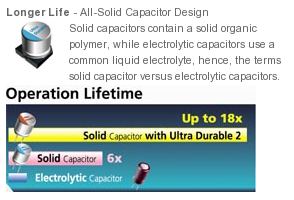
All the hardware manufacturers currently on the market boast and brag about not using anything other than the latest solid-core capacitors on their high-end motherboards. Perhaps the most notable of these is Gigabyte, which has been touting its “Ultra-Durable” brand of capacitors more than any other manufacturer. According to Gigabyte, their capacitors will last up to 18 times longer than standard electrolytic capacitors, and 3 times longer than the solid-core capacitors used in other high-end motherboards:

Gigabyte Capacitor Ultra-Durable 2

The problem is, these capacitors are also susceptible to internal damage and malfunctions, even if not as often. And when these capacitors do fail, it’s not as easy to tell nor as easy to fix.

Continue reading