Verified Accounts: Twitter’s Next Attempt at Making Money?

How much would you pay for people to know you’re really you? That the updates coming in every 2 minutes on that twitter page come from yours truly and not someone else… someone else pretending to be you?

If you’re like most people, the answer is not much. But there are people out there that really care, and with good reason. If you’re the FBI, Oprah Winfrey, or one of the million other celebrities currently on Twitter, you probably don’t want someone out there passing themselves off as yourself while posting fake updates to an account literally millions are watching.

Some people to whom money is not an issue already pay thousands of dollars for meaningless SSL certificates – something tucked away in the corner of your browser window that no one pays much attention to. But imagine if Twitter were to start offering “verified accounts” that have been authenticated as belonging to a particular person or institute… how many of these celebrity accounts would suddenly turn into cash cows for Twitter?

Continue reading

Mini DisplayPort to Get Some HDMI Competition

Back in 2008, Apple introduced the new Mini DisplayPort standard as the only video output method on the new MacBooks and LCDs. Mini DisplayPort is a freely-licensed VESA standard [1] and has now been adopted by a number of other display manufacturers, and is a miniaturized version of the original DisplayPort interface.

This week, the fourth revision of the HDMI high-definition video output connector was revealed in the form of HDMI D, weighing in at a mere fraction of the original HDMI connector size and intended for use with mobile and embedded high-definition video devices [2]. The new HDMI connector is expected to ship later this year, and is in direct competition with VESA’s Mini DisplayPort interface.

VESA is the international governing body for computer graphics standards, and has been designing video output standards since its conception in the late 80’s [3]. HDMI is a private group formed in 2002, and licenses its interfaces out to manufacturers at four cents a device + a $10,000 yearly fee.

Continue reading

Windows 7 Discontinues Ultimate Extras

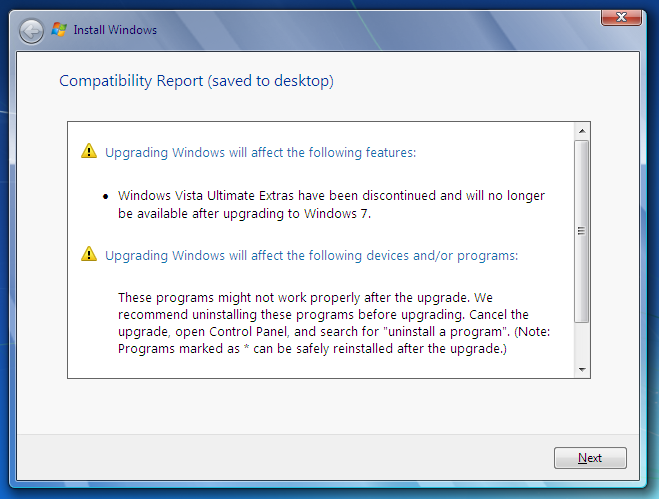
Users attempting to upgrade from Microsoft Windows Vista Ultimate Edition to Windows 7 Build 7100 (the unofficial RC1 release leak), are greeted with the following "compatibility warning" dialog:

Windows 7 has discontinued Vista's "Ultimate Extras"

Windows Vista Ultimate Edition’s "Ultimate Extras" have been a constant source of derision and anger from Vista users ever since its release 3 years ago. If the blog posts are to be believed, millions of users purchased Windows Vista Ultimate Edition in the hope that the added-value "Ultimate Extras" package – which was left un-described and of unknown worth at the time – would turn out to be a good investment.

Continue reading

On the matter of Firefox and memory leaks…

Recently our original article/rant on Firefox’s legendary memory abuse has seen an increase in comments and views; and I had intended to post the following comment in light of the article’s rebirth and the ensuing discussions in the comments.

The reply turned out to be longer than I’d originally intended, so here it is as its own post.

I’ll try to be as objective as possible in this reply:

The most important thing for frustrated end users to keep in mind is that Mozilla/Firefox cannot be held responsible for cases where incorrectly written plugins and/or extensions cause Firefox to abuse system memory – that’s the trade-off between empowering developers and keeping the code squeaky clean.

Most of the cases reported are indeed caused by one or more extensions or plugins gone awry, doing something they shouldn’t be doing, or something they don’t know how to do properly. Some of the most popular plugins for Firefox are notorious for their memory leaks; but few users realize just how dangerous they can be, and that the Firefox devs cannot really do anything about it.

At the same time, there can be no doubt that Firefox has some memory leaks in the codebase itself. They’re clearly not easily reproducible and they don’t happen very readily nor often enough because the developers have clearly spared no effort in their attempts to address this problem for once and for all. But they’re there, nevertheless.

Continue reading

Does it GTK/QT/Win32 Really Matter for Chrome?

128px-GoogleChromeLogo.pngA recent article on OSNews highlights the changes expected to come in Google’s Chrome 2.0 for Windows and the progress being made on the Linux and OS X fronts for Google’s new browser.

In the article, Ben Goodger, lead Chrome UI developer, states

[Google avoids] cross platform UI toolkits because while they may offer what superficially appears to be a quick path to native looking UI on a variety of target platforms, once you go a bit deeper it turns out to be a bit more problematic.” [… Your applications end up] speaking with a foreign accent.

But there’s something we’re not getting here. Obviously given enough brilliant programmers and a good team lead to keep the different codebases in sync, going with native APIs is the better approach. But the reasons Goodger is offering aren’t very convincing.

Continue reading

Excellent Customer Service Means A Lot

At a time when the human touch comes at a premium, it’s always a relief to find a company or two that reply quickly, politely, and efficiently to customer support requests.

And the two companies that have impressed us with their support? Pubmatic and Assembla – both excellent startups that we highly recommend in their individual fields. Pubmatic is an ad-revenue optimization service that intelligently chooses between different ad providers to maximize your ad impressions and CPM rates. Assembla provides quality hosting of SVN and other services that cover all aspects of the software development cycles for teams & small companies.

Continue reading

Windows 7 Wallpapers Now Available for Download

NeoSmart Technologies’ gallery of Windows Vista wallpapers has been a huge hit over the past several years – despite what anyone might say about Vista itself, its collection of wallpapers and fonts is top-notch. And now it seems that Windows 7 isn’t going to be any different – from what we’ve seen, the wallpapers shipping with Windows 7 are pretty darn good.

The Official Windows 7 Wallpapers are now available for download from the NeoSmart Image Gallery. Only several wallpapers have been released accompanying various Windows 7 builds thus far, but we’ll keep adding new ones to the gallery as they’re shipped.

Here are some of our favorite new wallpapers:


You can see these and more at the gallery here, along with the old Windows Vista ones here and here.

Continue reading

Google Abandons Standards, Forks OpenID

A couple of hours ago, the Google Security Team posted an article claiming that Google’s made the switch to OpenID, joining Yahoo! and Microsoft in the ranks OpenID providers.

But it looks like someone may have been a bit to hasty to pull that switch (perhaps itching to get some of the limelight Microsoft has been receiving for adding OpenID to all Live ID accounts just the day before yesterday)… because whatever it is that Google has released support for, it sure as hell isn’t OpenID, as they even so kindly point out in their OpenID developer documentation (that media outlets certainly won’t be reading):

  1. The web application asks the end user to log in by offering a set of log-in options, including Google.
  2. The user selects the "Sign in with Google" option.
  3. The web application sends a "discovery" request to Google to get information on the Google authentication endpoint. This is a departure from the process outlined in OpenID 1.0. [Emphasis added]
  4. Google returns an XRDS document, which contains endpoint address.
  5. The web application sends a login authentication request to the Google endpoint address.
  6. This action redirects the user to a Google Federated Login page.

As Google points out, this isn’t OpenID. This is something that Google cooked up that resembles OpenID masquerading as OpenID since that’s what people want to see – and that’s what Microsoft announced just the day before.

It’s not just a “departure” from OpenID, it’s a whole new standard.

Continue reading

ToolTipFixer 2.0 Released!

NeoSmart Technologies first released ToolTipFixer to great acclaim last June, over a year ago now. Since then, the downloads have kept on pouring in – along with a number of suggestions that we’ve taken to heart and hopefully implemented in a way that will please our users.

You can now download ToolTipFixer 2.0 which has a number of changes and improvements based on the feedback we’ve received during the past year. First, for those of you that aren’t familiar with ToolTipFixer, it’s a nifty “patch” for a very frustrating bug in Windows which winds up rendering tooltips behind the taskbar, leaving them unreadable and generally annoying the user to no end:

ToolTipFixer sits silently and invisibly in the background, intercepting this problem and fixing it as it happens – letting you read those tooltips and use your PC the way you should be able to.

Continue reading

Windows Isn’t For Gamers Anymore

For the past decade-and-a-half, “Windows” has been synonymous with “PC Gaming” – after all, no other PC platform has managed to satiate the undying hunger gamers are quite famous for. But now it seems that Windows is on the verge of losing its distinction as the gaming platform of choice – with nothing but Microsoft’s own machinations to blame.

Despite PC users’ widely-varying taste and preference in operating systems and platforms, gamers need Windows. In fact, one of the biggest reason people around the globe tend to dual-boot is their undying love for gaming and the fact that no other OS out there can boast the wide range of gaming titles and genres available for their platform like Windows can. The traditional choice faced by most non-Windows users has been to either install and dual-boot Windows or bite the built and buy a gaming console – ask us, we would know.

But this is all about to change, thanks to Microsoft’s reckless abandon for one of its few truly-loyal userbases.

When Microsoft first began its frenzied Vista marketing campaign in 2006, one of the points it focused on most and repeated over and over again was just how big of a gaming revolution Windows Vista was. Gaming was a large part of the Vista WOW campaign, but it has since failed to disappoint. But this isn’t an article about Vista, it’s about how Windows is poised to lose its gaming advantage if Microsoft doesn’t get its act together sometime soon.

Continue reading